


Social Control
How religious systems regulate
behavior, identity, and belonging.
Social control refers to the ways religious systems regulate behavior, identity, and belonging in order to maintain conformity and authority. While all communities have norms and expectations, high-control religious environments go further—using fear, shame, and relational pressure to shape how people think, behave, and understand themselves.
These dynamics are often subtle and internalized over time. What may begin as guidance or community values can gradually limit autonomy, discourage questioning, and make belonging feel conditional. Understanding social control helps explain why leaving—or even doubting—a religious group can feel disorienting, frightening, or isolating long after the beliefs themselves have changed.
What is a High Control Religious Group?
High control groups use social control to recruit, rewire, and retain their members. Two models are helpful to understand social control:
Bounded Choice Theory- What indicators describe the person’s experience of social control
B.I.T.E. Model of Authoritarian Control- What indicators describe the group

Bounded Choice Theory (by Janja Lalich)
Bounded choice is sociological model that explains how a person’s ability to think and choose freely becomes constrained. When the following occur, free choice gives way for a BOUNDED choice - a way of thinking that is predetermined by the group’s influence.
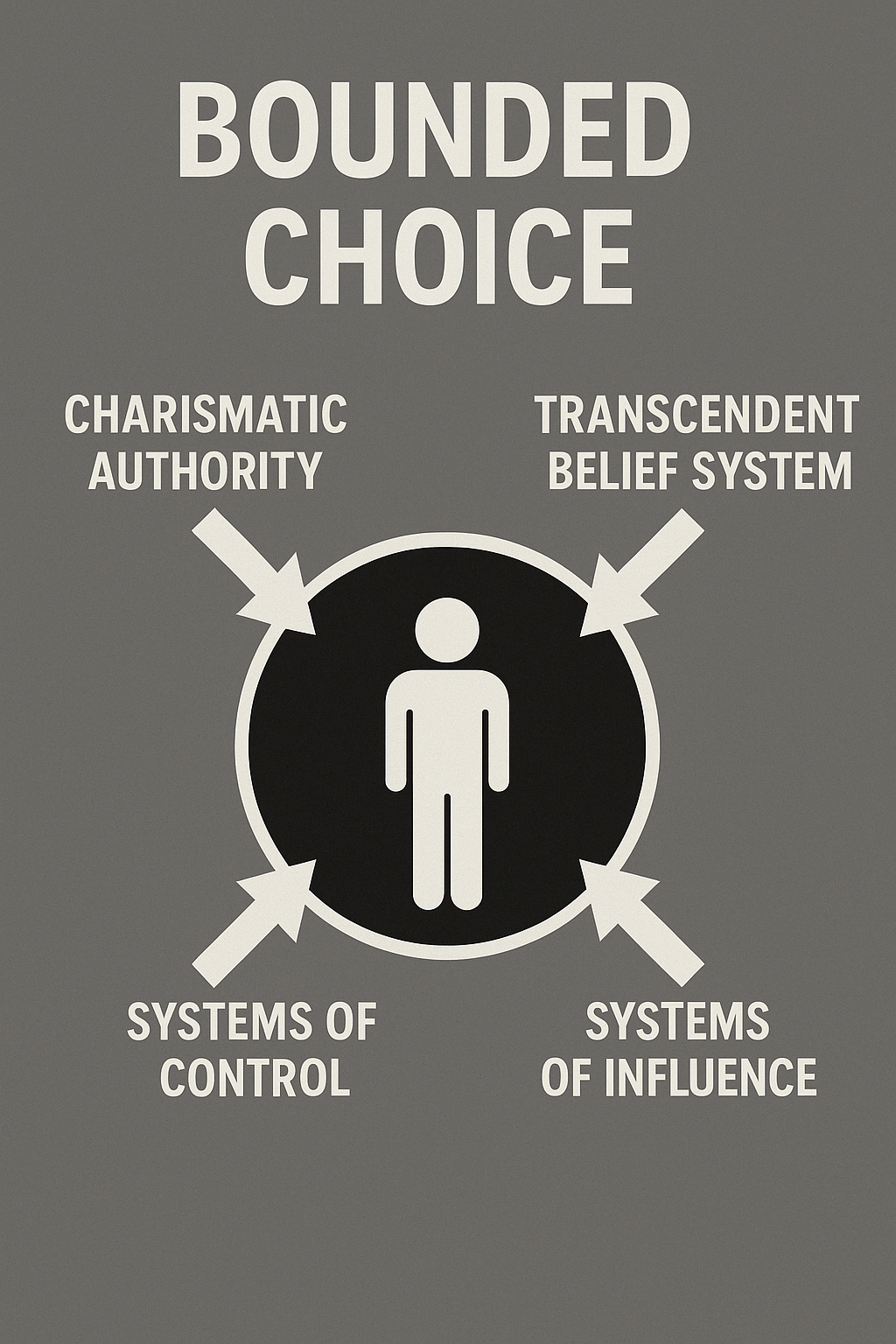
Charismatic Authority
An emotional relationship with a figure (human and/or a divine) that maintains connection through love and fear. The leader or ideology becomes the only source of truth.
Transcendent Belief System
Gives a total explanation for past, present and future including a path to salvation. A closed system of meaning is created—alternative ideas become unthinkable. The person’s identity and worldview become fused with the group.
Overt group rules that are strictly enforced. The individual comes to self-regulate in accordance with group rules, even without external pressure.
Systems of Influence
Systems of Control
Covert group norms which members copy to adopts a group identity.
Learn more at LalichCenter.org
Janja Lalich on Bounded Choice Theory
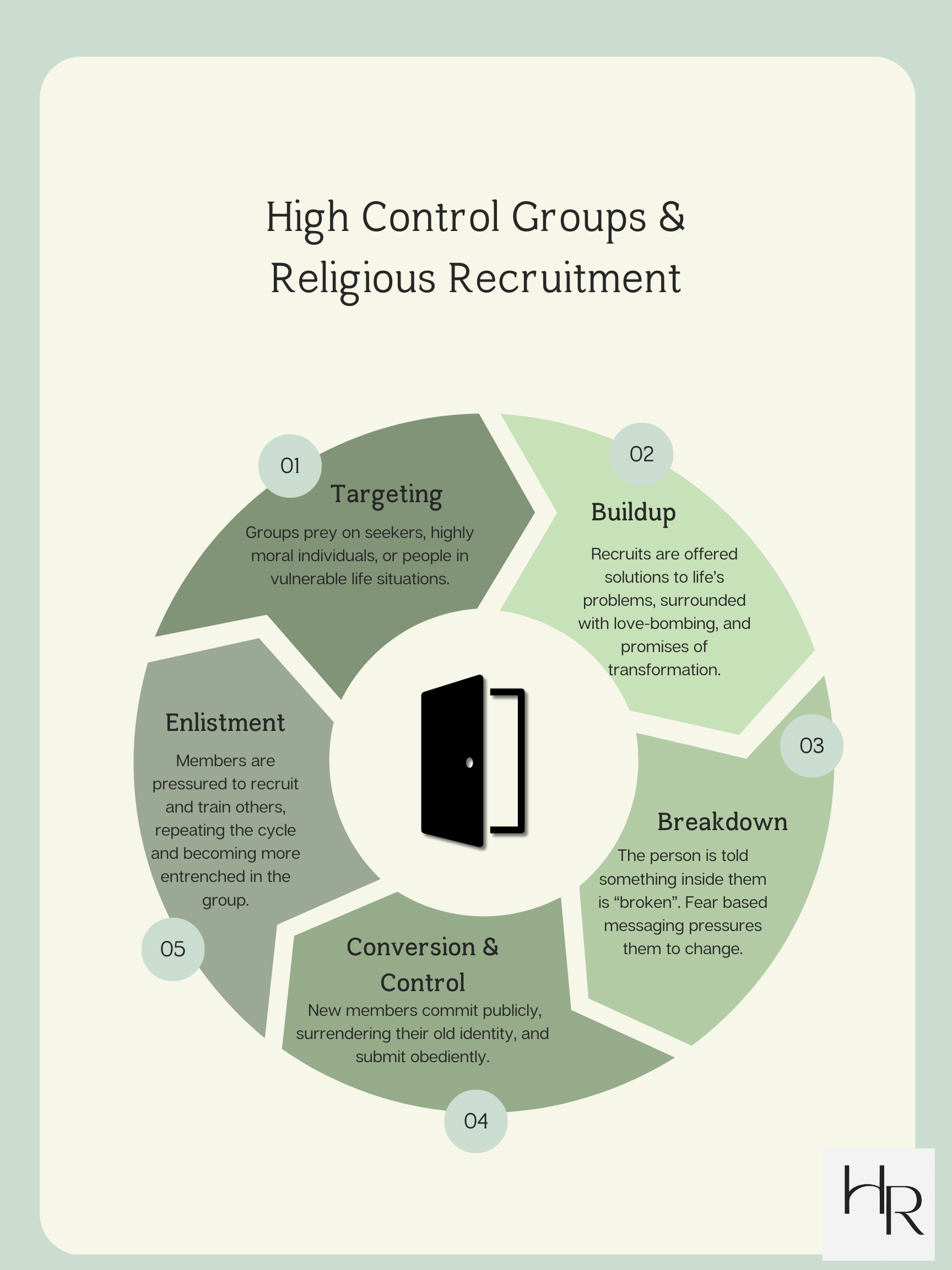
High-control religious groups often follow recognizable stages of recruitment and retention. These stages rely on emotional connection, fear, and increasing commitment to draw individuals deeper into the system and make leaving feel increasingly costly
B.I.T.E. Model of Authoritarian Control
Steven Hassan’s
While recruitment and group dynamics explain how people become entangled in high-control environments, the B.I.T.E. Model helps clarify what is being controlled. This framework outlines the specific ways authoritarian systems influence behavior, access to information, thinking patterns, and emotional experience.
In these environments, members are subject to numerous rules and teachings that govern behavior, beliefs, and daily life. These expectations are often framed as pathways to moral purity, ways to please God, or means of avoiding divine punishment. Religious texts are frequently cited as sources of unquestionable authority to justify these rules, while additional expectations are imposed by religious leaders themselves.

Behavior Control
-
Strict rules for what you can wear, hairstyle, makeup, body piercings, tattoos, etc.
-
When, how and with whom the member has sex
-
Control over food and drink, hunger and/or fasting
-
Control over member’s finances, exploitation of labor, large financial sacrifices expected.
-
Permission and approval required for career decisions. Emphasis placed on jobs that are “approved” by the group.
-
Increases in time commitment expected over time. Restrict leisure, entertainment, vacation time.
Learn More at FreedomofMind.com

Information Control
-
Deliberately withhold information.
Distort information to make it more acceptable.
Systematically lie. -
Internet, TV, radio, books, articles, newspapers, magazines, media
Critical information
Former members
Keep members busy so they don’t have time to think and investigate
Control through cell phone with texting, calls, internet tracking
-
Ensure that information is not freely accessible
Control information at different levels and missions within group
Allow only leadership to decide who needs to know what and when
-
Impose a buddy system to monitor and control member
Report deviant thoughts, feelings and actions to leadership
Ensure that individual behavior is monitored by group
-
Group generated “facts” from newsletters, magazines, journals, audiotapes, videotapes, YouTube, movies and other media
Misquoting external statements or using them out of context from non-cult sources

Thought Control
-
Require members to internalize the group’s doctrine as truth
Adopting the group’s ‘map of reality’ as reality
Instill black and white thinking
Determine between good vs. evil
Organize people into us vs. them (insiders vs. outsiders)
-
Change person’s name and identity
-
Use of loaded language and clichés which constrict knowledge, stop critical thoughts and reduce complexities into platitudinous buzz words
-
Encourage only ‘good and proper’ thoughts
Techniques:
a. Denial, rationalization, justification, wishful thinking
b. Chanting
c. Meditating
d. Praying
e. Speaking in tongues
f. Singing or humming -
Hypnotic techniques are used to alter mental states, undermine critical thinking and even to age regress the member
-
Memories are manipulated and false memories are created
-
Rejection of rational analysis, critical thinking, constructive criticism
-
Forbid critical questions about leader, doctrine, or policy allowed
-
Labeling alternative belief systems as illegitimate, evil, or not useful
-
Instill new “map of reality”

Emotional Control
-
Manipulate and narrow the range of feelings – some emotions and/or needs are deemed as evil, wrong or selfish
-
Teach emotion-stopping techniques to block feelings of homesickness, anger, doubt
-
Make the person feel that problems are always their own fault, never the leader’s or the group’s fault
-
a. Identity guilt
b. You are not living up to your potential
c. Your family is deficient
d. Your past is suspect
e. Your affiliations are unwise
f. Your thoughts, feelings, actions are irrelevant or selfish
g. Social guilt
h. Historical guilt -
Instill fear, such as fear of:
a. Thinking independently
b. The outside world
c. Enemies
d. Losing one’s salvation
e. Leaving or being shunned by the group
f. Other’s disapproval -
Extremes of emotional highs and lows – love bombing and praise one moment and then declaring you are horrible sinner
-
Ritualistic and sometimes public confession of sins
-
Inserting irrational fears about leaving the group or questioning the leader’s authority
a. No happiness or fulfillment possible outside of the group
b. Terrible consequences if you leave: hell, demon possession, incurable diseases, accidents, suicide, insanity, 10,000 reincarnations, etc.
c. Shunning of those who leave; fear of being rejected by friends and family
d. Never a legitimate reason to leave; those who leave are weak, undisciplined, unspiritual, worldly, brainwashed by family or counselor, or seduced by money, sex, or rock and roll
e. Threats of harm to ex-member and family