Religious Trauma
The lasting impact of religious harm on a person’s
mental, emotional, relational, and physical well being.
Cause and Effect:
Understanding Religious Trauma
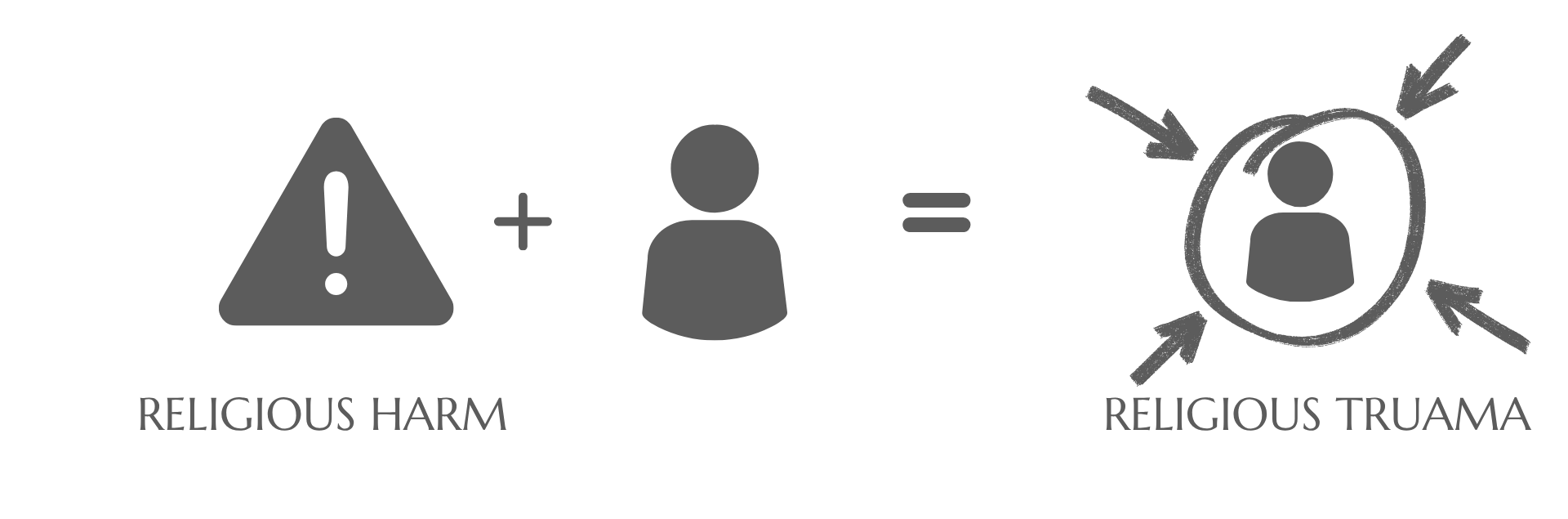
Religious Trauma develops after harmful religious experiences such as abuse, harmful theology, high control group dynamics, or the costs of changing beliefs.
It is the injury a person carries- “the wounds”- to their identity, nervous system, relationships, mental health, sense of meaning, etc.
Abuse
Harmful Theology
High Control Dynamics
Leaving a Group
Mental Health
Emotional Health
Relationships
Nervous System
How trauma research informs our understanding of religious trauma
Trauma research helps explain why religious harm can have such deep and lasting effects—
even when no single catastrophic event occurred.
Trauma Research
Research on trauma has expanded significantly in recent decades. Early work focused on the mental health of war veterans and survivors of natural disasters, revealing a common set of symptoms that often follow major disruptive events. A cause and effect was established- highlighting the mental health implications of harmful events. Later, Judith Herman’s work deepened this understanding by identifying the trauma that develops through chronic, repeated exposure rather than a single incident, known as complex trauma.
Trauma results from an event, series of events, or set of circumstances that is experienced by an individual as physically or emotionally harmful or life threatening and that has lasting adverse effects on the individual’s functioning and mental, physical, social, emotional, or spiritual well-being
-Substance Abuse and Mental Health Services Administration
Trauma involves exposure to a stressful event or situation of an exceptionally threatening or catastrophic nature, which is likely to cause pervasive distress.
-World Health Organization
Religious trauma is understood through this same lens—where prolonged exposure to threat, fear, or control reshapes a person’s nervous system, beliefs, and sense of self.
Defining Trauma
Defining Religious Trauma
In the past, religion was often seen as a positive force — a way for people to build community and find shared meaning. But over time, psychologists began to recognize that religious experiences aren’t always helpful or healthy.
In 2011, Dr. Marlene Winell introduced the term Religious Trauma Syndrome to describe the symptoms people may experience after leaving or questioning authoritarian, dogmatic, or high-control religious groups. We also find that religious trauma can affect people who remain religious, and people who are still questioning—especially when belief systems are authoritarian, fear-based, or identity-controlling.
Official research for defining religious trauma is ongoing. Since Dr. Winell’s work started, more mental health professionals have been researching and speaking out about the impact of religious harm.
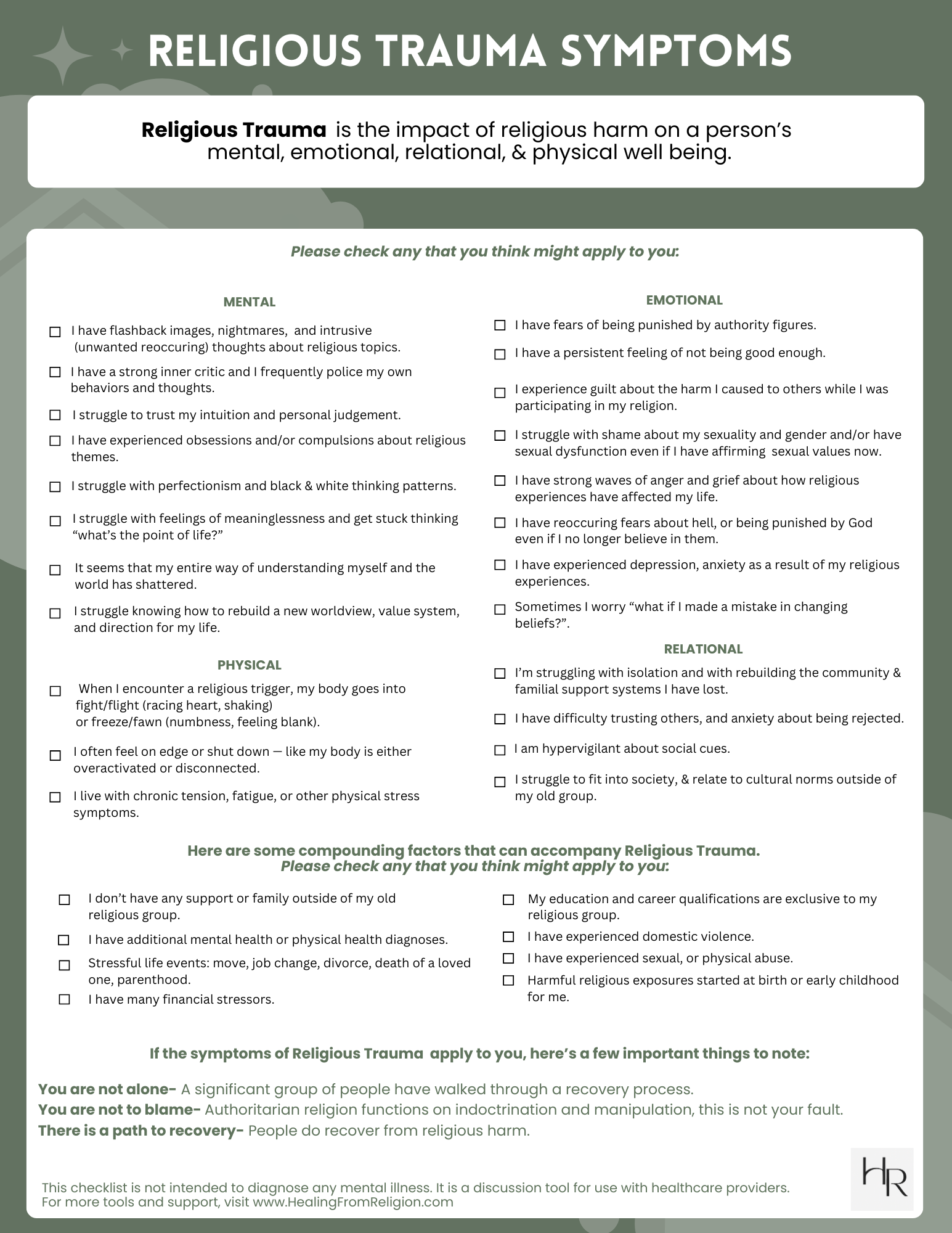
Symptoms of Religious Trauma
People experience religious trauma in different ways.
You do not need to relate to every item for your experience to be valid.
THINKING
& BELIEFS
-
I have flashback images, nightmares, and intrusive (unwanted reoccuring) thoughts about religious topics.
-
I have a strong inner critic and I frequently police my own behaviors and thoughts.
-
I struggle to trust my intuition and personal judgement.
-
I have experienced obsessions and/or compulsions about religious themes. Religious scrupulosity is also a form of OCD.
-
I struggle with perfectionism and black & white thinking patterns.
-
I struggle with feelings of meaninglessness and get stuck thinking “what’s the point of life?”
-
It seems that my entire way of understanding myself and the world has shattered.
-
I struggle knowing how to rebuild a new worldview, value system, and direction for my life.
EMOTIONS
-
I have fears of being punished by authority figures.
-
I have a persistent feeling of not being good enough.
-
I experience guilt about the harm I caused to others while I was participating in my religion.
-
I struggle with shame about my sexuality and gender and/or have sexual dysfunction even if I have affirming sexual values now.
-
I have strong waves of anger and grief about how religious experiences have affected my life.
-
I have reoccuring fears about hell, or being punished by God even if I no longer believe in them.
-
I have experienced depression, anxiety as a result of my religious experiences.
-
Sometimes I worry “What if I made a mistake in changing beliefs?”.
PHYSICAL
-
When I encounter a religious trigger, my body goes into fight/flight (racing heart, shaking) or freeze/fawn (numbness, feeling blank).
-
I often feel on edge or shut down — like my body is either over-activated or disconnected.
-
I live with chronic tension, fatigue, or other physical diagnosis with a psychosomatic origin.
-
I have difficulty with sexual interactions as a result of religious teachings.
RELATIONAL
-
I’m struggling with isolation and with rebuilding the community & familial support systems I have lost.
-
I have difficulty trusting others, and anxiety about being rejected.
-
I am hypervigilant about social cues.
-
I struggle to fit into society, & relate to cultural norms outside of my old group.
Download this Religious Trauma Symptoms worksheet to explore how religious harm may be affecting your mental, emotional, relational, and physical well-being. It can be used for self-reflection or as a conversation tool in therapy.