

the experience of re-evaluating,
questioning or changing one’s religious views.
Deconstruction
Deconstruction is a term for describing a type of religious transition. In a practical sense, to deconstruct, is the action of taking something apart. Within a religious context this word describes the experience of re-evaluating, or changing aspects of one’s religious faith, often changing core tenants. Deconversion, is the experience of completely unaffiliating with a religious identity.
Types of Religious Change
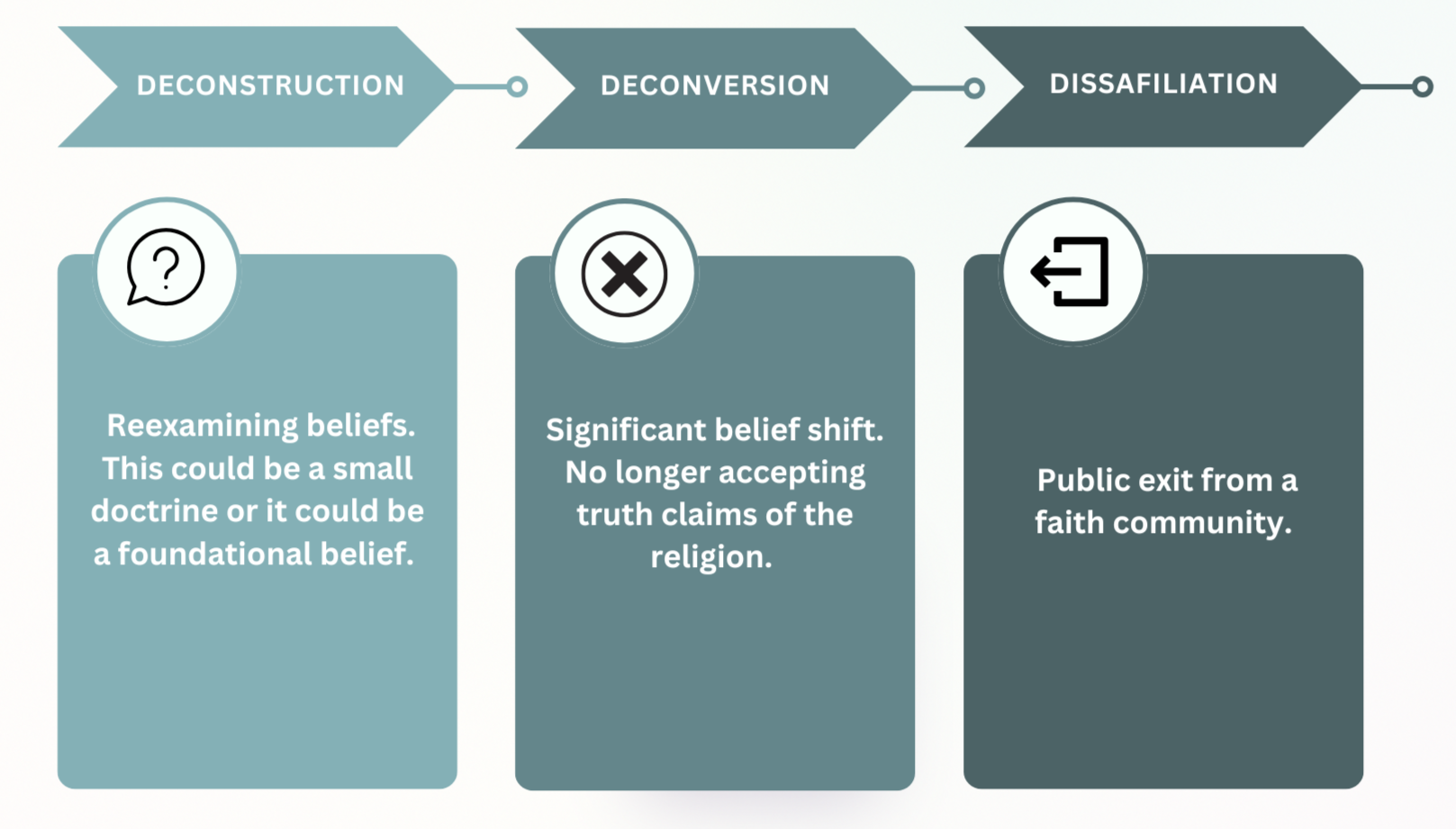
Religious change does not happen in a single moment, and it does not look the same for everyone. People may move slowly, quietly, or publicly through different stages of questioning and change. Deconstruction, deconversion, and disaffiliation are all types of religious changes. Some changes like deconstruction can be private while others, like disaffiliation, are often public.

Exit Costs
The losses associated with doubting
religious beliefs or leaving a group
If you’ve ever wondered why questioning your faith felt terrifying—or why leaving came with so much loss—you’re not alone. Exit costs help explain the emotional, relational, and practical pressures that keep people tied to religious systems long after doubts arise. Understanding these dynamics can be an important step toward self-compassion and healing.
Exit costs refer to the losses—real or anticipated—that can accompany doubting, questioning, or changing one’s religious beliefs. For many people, religious identity is deeply woven into family relationships, community belonging, moral frameworks, and practical life structures. Because of this, even small shifts in belief can carry significant emotional, social, and material consequences.
Understanding exit costs helps explain why leaving a religion—or even privately questioning it—can feel frightening, destabilizing, or impossible, even when a belief system has become harmful.
Exit costs are one of the primary mechanisms that keep people tied to religious systems long after doubts arise. When belonging, safety, or survival feel threatened, staying may appear less painful than leaving—even when remaining causes harm. Exit costs take on many forms including: relational, psychological, economic, existential, developmental, cultural, & safety.

RELATIONAL COSTS
Exclusion from former religious community, friendships, and connections.
Being labelled as bad or evil for leaving the region. Most religious groups have a shaming label for people who leave.
Relational conflicts over differing views.
Loneliness and feelings of isolation.

PSYCHOLOGICAL COSTS
Identity collapse
Loss of a meaning making system
Shifts in relationship to self
Emotions such as grief, anger, fear
Mental health challenges such as depression and anxiety

ECONOMIC COSTS
Loss of career if connected to religious group
Loss of childcare, financial support, community resources
Loss of business relationships
Education gaps if job training was religious

EXISTENTIAL COSTS
Loss of defined purpose and identity
Fears about death
Loss of moral framework

DEVELOPMENTAL COSTS
Relearning autonomy and self-direction that the group once dictated for you.
Reclaiming of intuition and self trust
Catching up on missed sexual development and creating a sexual ethic outside of prescribed religious rules

CULTURAL COSTS
Separation from familiar holidays and rituals
Loss of language, symbols, and heritage to connected faith
Disconnection from ethnic identity (for fused groups)

SAFETY COSTS
Emotional abuse or coersion to return
Domestic Violence risks
Forced counseling, church discipline
Surveillance